My work focuses on the systems and ideas shaping a world where humans and AI agents work together—and what that shift means for companies, countries, and the economy.
Playing the transition · choose a view to stay with it
ONE TRANSITION. THREE SCALES.
The nature of work↗The shape of organizations↗The architecture of economies
01 / THE IDEAS
A few ideas I keep coming back to.
A new actor. A different economy.
The new actor is an AI agent: software that can work toward goals, take action within agreed boundaries, and coordinate with people and other agents. The shift is from software we use to systems we work with—and it changes how work is organized and value is created.
These are some of the questions that guide my work.
01AI laborFrom answering questions to doing useful work.
A tool produces an output. A worker carries an objective over time. The distinction is not simply a more capable model; it is an agent with identity, memory, authority, and accountability inside a real process.
What makes an agent a worker?
02The hybrid organizationOne organization. Two kinds of worker.
When humans and agents share work, the organization needs more than a collection of AI tools. Objectives, managerial responsibility, escalation, permissions, and performance have to fit into one coherent operating model.
How does an organization manage both?
03The agentic economySoftware as a participant in economic life.
Once software can perform work and participate in transactions, questions of ownership, incentives, markets, and accountability become central. “Economic actor” describes this expanded role; it does not, by itself, imply legal personhood.
What institutions does this new actor require?
04Sovereign laborFrom access to intelligence to control of capacity.
A lens for examining AI labor at national scale: who operates the infrastructure, where work and data reside, and how control and accountability are maintained. The focus extends from compute and models to agents and the institutions around them.
Who controls a country’s AI productive capacity?
05The Great RebalancingA changing relationship between labor, capital, and scale.
My term for the changing division of work between people and agents—and for the broader questions it raises about economic capacity, organizational advantage, and the distribution of value.
What changes when productive capacity can scale differently?
PEOPLE, AI & THE WORLD OF WORK
THE AGENTIC AGE / ROTEM ALALUF
02 / THE BOOK
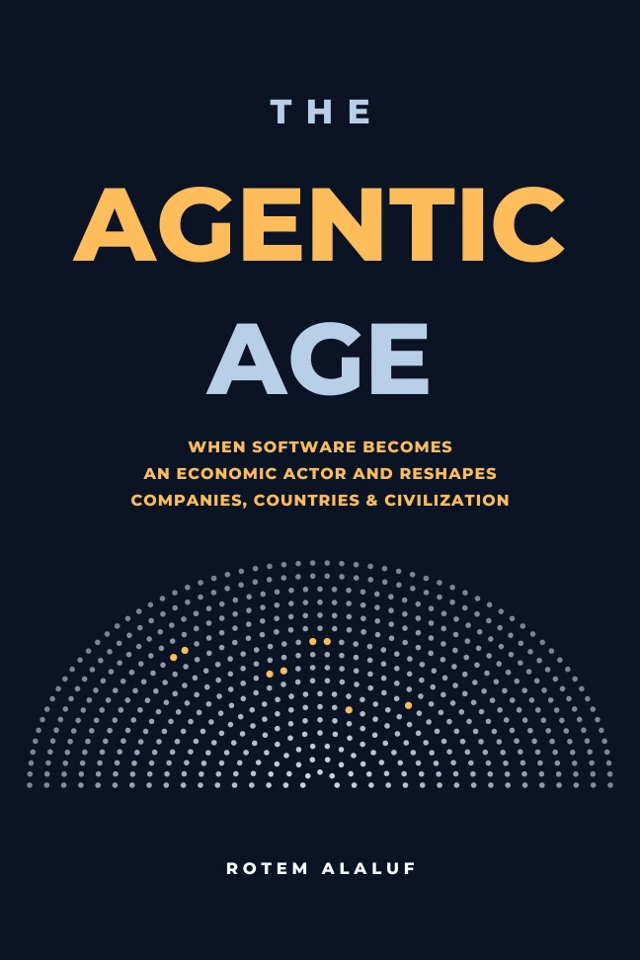
The Agentic Age.
When Software Becomes an Economic Actor and Reshapes Companies, Countries & Civilization
In The Agentic Age, I explore what happens when AI becomes part of the workforce—and what that means for the organizations, institutions, and economies around it.
The book brings these questions together in a framework for understanding the changes ahead.
Much of this work starts with practical questions from real organizations. Working through them with teams helps me see what is useful, what is difficult, and what still needs to change.
THE COMPANYFOUNDER & CEO
Wand↗
Helping people and AI agents work together.
At Wand, we’re building the infrastructure for people and AI agents to work as one team—with shared objectives, oversight, and clear accountability.
I’ve spent much of my career working on AI in real organizations.
I’m the founder and CEO of Wand AI and the author of The Agentic Age. Before Wand, I founded and led AI companies and worked on systems across defense, intelligence, financial services, and enterprise technology.
Today, my work focuses on how people and AI agents can work together—and what companies, countries, and institutions need to learn, build, and rethink as that relationship evolves.
I also invest in AI companies, guest lecture at universities including UC Berkeley, and serve on advisory boards for global organizations, including EY.